Why the operating environment picks the polymer
Material selection · June 5, 2026 · 10 min read
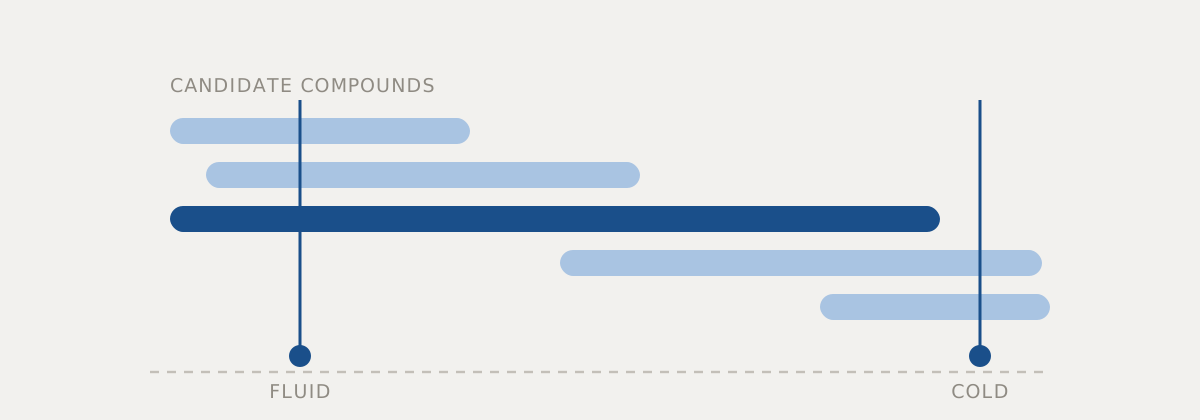
Most components in an assembly are specified twice: once by geometry and once by material. A bracket gets a grade, a condition and a tolerance. The elastomer bolted next to it frequently gets a colour, a hardness figure and a family name, and that is the whole specification. It is treated as a commodity that fills a gap rather than as a material that has been chosen.
The reason this survives is that elastomers rarely fail by breaking. They fail by changing — losing force, swelling, hardening, cracking at the surface — and those failures arrive late enough that the specification is never revisited. The choice that determines all of it is made at the level of backbone chemistry, and it is made against the environment rather than against the load.
Natural rubber is one polymer, not a category
Natural rubber is a specific molecule: a long, regular, highly unsaturated hydrocarbon chain. Two consequences follow from that regularity and that unsaturation, and they pull in opposite directions.
The regularity lets the chains align and crystallise when the material is stretched. Crystallites form at the tip of a growing tear and blunt it, which is why natural rubber has such high tear strength and fatigue life, and why it develops useful strength even with modest reinforcement. For parts that are loaded and unloaded millions of times — engine mounts, suspension bushes, conveyor covers, flexible couplings — that self-toughening behaviour is very difficult to match.
The unsaturation is the bill for it. Every double bond in the backbone is a site where ozone and oxygen can attack, and a hydrocarbon chain with no polar groups has nothing to resist a hydrocarbon oil, which dissolves into it and swells it. So natural rubber is not a weak material chosen for cheapness. It is a strong material with a narrow environment: mechanical duty, moderate temperatures, no hydrocarbons, no persistent ozone exposure under strain.
The synthetic families are answers to specific vulnerabilities
It helps to read the synthetic elastomers not as substitutes but as edits — each one removing a particular weakness and paying for it somewhere else.
Styrene-butadiene rubber trades the strain-crystallisation away for consistency and process control, which is a reasonable exchange in a reinforced compound and a poor one in a part that relies on fatigue life.
Polychloroprene puts a chlorine atom on the chain. That does two things at once: it makes the polymer polar enough to resist oil swelling to a useful degree, and it reduces the reactivity of the remaining double bonds, which improves weathering. It is the classic compromise material, better than natural rubber in most environments and better than nothing in almost all of them.
Nitrile rubber turns polarity into an adjustable parameter. Raising the acrylonitrile fraction makes the polymer more polar, so hydrocarbon oils dissolve into it less readily; the same change stiffens the chain and raises the temperature at which the material goes glassy. Oil resistance and low-temperature flexibility are therefore not two independent requirements that a compounder can satisfy separately. They are one dial turned in opposite directions, and any specification that demands both at their extremes is asking for a material that does not exist in that family.
Hydrogenating a nitrile removes the residual double bonds while keeping the polarity, which is the direct answer to a part that needs oil resistance and heat and ozone resistance.
Ethylene-propylene-diene rubber goes further and offers a backbone with essentially no unsaturation in the main chain at all. Ozone, oxygen, sunlight, hot water and steam have very little to attack. The same non-polar structure that resists water makes it swell severely in hydrocarbon oil, which is why it appears constantly in weather seals, cooling systems and brake components and almost never in fuel systems.
Butyl rubber is dense with methyl side groups, which obstruct the diffusion of gas molecules through the material. It is chosen for what it stops passing through, a property no strength test measures.
Silicone abandons the carbon backbone entirely for a silicon–oxygen chain. The bond is strong and the chain is unusually free to rotate, so the material stays rubbery across a very wide temperature span and its stiffness changes little across it. The cost is mechanical: unreinforced strength and tear resistance are low, and it is a poor choice anywhere the part is dragged, pinched or loaded hard.
Fluoroelastomers surround the backbone with fluorine, whose bonds are strong and whose atoms physically shield the chain behind them. That yields the broadest chemical and thermal resistance available in the class, paid for with stiffness at low temperature and with cost.
Polyurethanes are different in kind: they derive strength from hard segments phase-separated within a soft matrix, which gives exceptional abrasion resistance and load capacity. The phase structure is also the weakness, because the linkages holding it together can be broken by hot water.
The environment is several constraints at once, and they conflict
Selection goes wrong when one environmental factor is treated as the requirement. The real specification is usually a list, and the list frequently contains a contradiction.
Oil resistance and low-temperature flexibility conflict, because both follow from chain polarity. Steam resistance and hydrocarbon resistance conflict, because the polymers that ignore water are the ones that dissolve in oil. Ozone resistance and fatigue performance conflict in the same way, since the double bonds that ozone attacks are also what makes a chain regular enough to crystallise under strain.
When the list contains a contradiction, no compound resolves it — the design does. Shielding a part from direct sunlight, keeping a joint below the temperature at which the fluid attacks the seal, reducing installed strain so that ozone has no crack to open: these are geometry decisions, and they are cheaper than searching for a polymer that does not exist.
The family narrows the field; the compound decides the part
A family name is the beginning of a specification, never the end of one. What is actually moulded is a compound: polymer, reinforcing filler, plasticiser, cure system and protective additives. Two compounds carrying the same family name can differ more from each other than either differs from a neighbouring family.
Filler loading sets stiffness, hysteresis and abrasion behaviour. Plasticiser sets low-temperature flexibility — and can be extracted by the very fluid the part is sealing, so a compound can pass a short test and stiffen in service as the plasticiser leaves. The cure system determines how much of the network survives heat, and therefore how much of the family’s nominal temperature capability the part actually has.
Which is why the useful question at selection time is not “which rubber is best”. It is: what is this part immersed in, at what temperature, under what strain, for how long, and which of those is the one that will change the material first.