Compression set, and why seals fail slowly
Sealing · June 22, 2026 · 10 min read
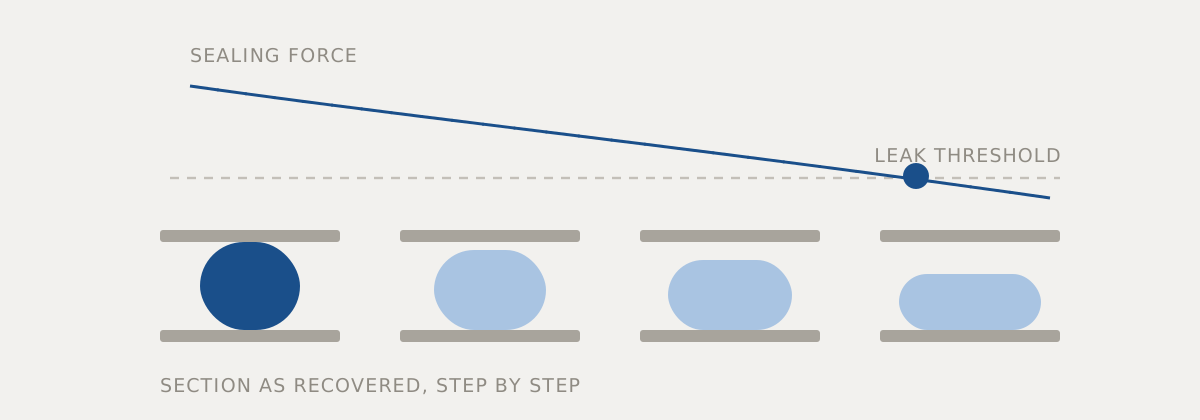
A static elastomeric seal is a spring that has been compressed and left there. Squeezing the section into a gland stores elastic energy; that energy appears as contact stress along two bands where the seal touches the gland floor and the mating face. As long as contact stress exceeds the pressure trying to get past — plus whatever margin the surface finish demands — nothing flows.
Nothing in that description mentions strength. A seal that has lost none of its tensile strength and none of its elongation can leak, and a seal that leaks is usually still perfectly intact when it is removed. What has changed is the force, and the force decays from the moment of assembly.
The network rearranges around the shape it is held in
Hold an elastomer at constant strain and two distinct processes run in parallel.
The physical one is fast and largely finished early: chains slip past one another, entanglements resolve, and the filler network reorganises around the imposed deformation. This is recoverable in the sense that nothing has been broken, and it accounts for the sharp initial drop in force that anyone who has retorqued a gasketed joint has seen.
The chemical one is slow and permanent. Crosslinks and chain segments break under the combined action of heat, oxygen and strain, and new crosslinks form — but they form in the deformed geometry. Each new bond made while the material is squashed treats the squashed shape as the new zero-stress state. The material is progressively rebuilt around the shape it happens to be in, so the strain that used to generate force generates less of it.
That is the mechanism behind compression set. It is not fatigue, it is not creep under load in the metallic sense, and it does not require the seal to move. A seal sitting motionless in a warm housing is being rewritten.
Set and relaxation are different measurements, routinely conflated
Compression set is measured by deflecting a specimen by a fixed amount, holding it, releasing it, and recording how much of the deflection did not come back. It is a geometric result taken after the load is removed.
Stress relaxation is measured by deflecting a specimen by a fixed amount and recording how the force decays while it is still held. It is a force result taken under load.
These are related but they are not interchangeable, and the industry uses the phrase “the seal has taken a set” for both. The distinction matters because a seal in service is never released. What determines whether it leaks is the remaining contact stress, which is the relaxation result. A compound can show substantial permanent deformation on release while still generating adequate force in the gland — and, less often but more dangerously, a compound can recover its geometry well while having lost much of its force at temperature.
If a supplier quotes only a set figure, what has been characterised is how much shape came back, on one geometry, at one temperature, for one duration. That is a comparative ranking between compounds. It is not a prediction of your joint.
Why the failure looks slow, and why “sudden” reports are usually threshold crossings
Contact stress declines smoothly. Sealing is a threshold. Put those together and the observable behaviour is a long period in which absolutely nothing happens, followed by a weep that is easy to mistake for an event.
The threshold is not a single number either. It moves. Contact stress must beat the fluid pressure, so a pressure excursion can cross the threshold months before steady-state operation would. It must also bridge the surface roughness of the mating face, so a seal on a scratched or scuffed counterface crosses earlier. And because the elastomer stiffens as it cools, a joint that seals adequately hot can drop below the threshold on a cold start — the classic symptom of a seal that has taken set at temperature, where the leak appears first thing in the morning and stops once the machine warms up.
Thermal cycling makes this explicit. A seal that has been rebuilt around its compressed shape at operating temperature contracts on cooling, and there is no longer enough stored strain to follow the gland as it opens. The set was accumulated hot; it is revealed cold.
There are genuinely abrupt elastomer failures, and it is worth separating them from this one. Extrusion into a clearance gap under pressure removes material. Rapid gas decompression tears a seal from the inside when dissolved gas expands faster than it can diffuse out. Chemical embrittlement can turn a seal brittle enough to fracture on the next disassembly. Those are events. Set is not; set is a slope.
What the mechanism implies for the gland, not just the compound
Because the force decays from a starting value, the useful design question is how much margin was there at the start, and set becomes a budget item rather than a material property.
Squeeze is the budget. A joint designed at the low end of a squeeze range has committed nearly all of its margin at assembly and has only the residue to spend on set, thermal contraction, tolerance stack and surface finish. The same compound in a gland designed nearer the middle of the range may last several times longer, with no change of material at all — which is the usual explanation when the same part number performs differently in two products.
Temperature is the accelerator, and it acts on the chemical process, so its effect is steep and non-linear. Reducing the temperature a seal actually sees — by moving it away from a heat source, by improving conduction out of the housing, by not routing the hot line past it — buys more life than most material changes available at the same cost.
Gland fill deserves a mention here too, since set interacts with it. The seal must have somewhere to go when it is squeezed and when it swells or expands thermally; a gland packed to capacity generates far higher contact stress than the design intended, which raises friction, accelerates relaxation and can force material into the clearance gap.
Finally, the honest conclusion: a static elastomeric seal has a service life, and that life is set by the rate at which its force decays in the environment it is actually in. Designing as though a seal is permanent, and then treating each leak as a defect to be investigated, misreads a scheduled event as a fault.