The triangle: hardness, sealing force and wear
Design trade-offs · July 9, 2026 · 10 min read
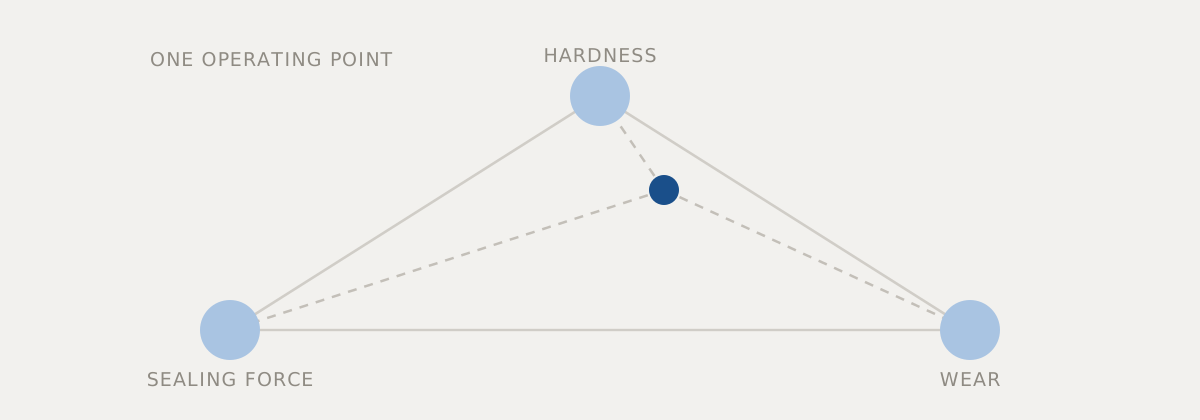
Ask why a particular seal is the hardness it is and the answer is usually inherited. Somebody specified it, it worked, and the figure propagated. It is the one number on the drawing that everyone recognises, so it absorbs the weight of decisions it cannot actually carry.
Hardness deserves better treatment than that, and less. It is a genuinely useful quantity — but as a production control on consistency, not as the variable a sealing design is tuned with. What the design is really trading is stiffness against conformity, and both against the way the material dissipates energy.
What a hardness number is measuring
A durometer presses a shaped indenter into the surface under a defined force and reports how far it fails to penetrate, on a bounded scale. It is a response to a non-uniform, mostly compressive, largely local deformation. It correlates with the material’s stiffness, but it is not a stiffness measurement, and the correlation is only dependable within a family and filler system.
Several consequences follow that catch people out. The scale is bounded, so it compresses badly at both ends: differences near the top of the range mean much less than the same number of points in the middle. The measurement samples a finite depth, so a thin part or a small cross-section reads softer than the same compound in a block, and a curved surface reads differently again. Different hardness scales exist, they are built on different indenter geometries and loads, and although published conversions between them exist they are approximations — a value on one scale and a value on another are not the same measurement with different units.
And “modulus” is a trap in this field, because in rubber technology the word is conventionally used for the stress at a stated elongation in tension, not for Young’s modulus. Two compounds can match on hardness and differ substantially on that tensile figure, because hardness is dominated by behaviour at small strain and the tensile figure describes behaviour at large strain. A seal deforms at neither extreme, which is precisely why matching the drawing hardness does not guarantee matching the part’s behaviour.
Stiffness buys pressure capability and spends conformity
For a given squeeze, a stiffer compound generates more contact stress. That is the first and most direct trade: it seals against higher pressure, and it resists being pushed into the clearance gap, because extrusion is a competition between the pressure driving material into the gap and the material’s resistance to flowing there. Hard compounds and back-up rings both address the same failure.
The costs arrive together. Contact stress is only useful where there is contact, and a stiffer material follows the microscopic texture of the mating face less willingly. Sealing at the small scale is a matter of the elastomer flowing into the valleys of the surface finish; a compound that will not do so leaves connected leak paths regardless of how much force it is generating overall. The same limitation appears at the macroscopic scale, where a stiff seal is less tolerant of an out-of-round bore, a warped flange or a step at a machining transition.
Stiffness also worsens low-temperature behaviour, since stiffness rises as the material approaches its glass transition and the same seal is stiffer on a cold morning than the specification implies.
The consequence is that “harder for a better seal” is only sound in one direction. Against pressure and extrusion, harder is better. Against roughness, distortion and cold, softer is better. A seal usually has to do both, and the resolution is normally geometric — improving the surface finish, tightening the clearance gap, adding a back-up ring — rather than another five points of hardness.
Wear is mostly not abrasion
The third corner is the one that gets simplified hardest. Abrasion resistance does tend to rise with filler loading and hardness, and against a genuinely abrasive counterface — grit, an as-cast surface, a contaminated fluid — that relationship holds well enough to design around.
But most dynamic seals do not run against an abrasive. They run against a ground or honed metal surface, and the dominant wear mechanism is fatigue: asperities on the counterface repeatedly deform the same patch of elastomer, cracks initiate below the surface, and material is lost in flakes rather than being scraped off. Fatigue wear does not follow hardness in the same direction. Resistance to it depends on tear strength and on the material’s ability to survive repeated straining, which reinforcement improves only up to a point and then degrades.
Friction complicates it further, because rubber friction is not the textbook kind. For most engineering materials, the real area of contact is a small fraction of the nominal area and friction force is roughly proportional to load. An elastomer conforms so completely that real and nominal contact areas approach one another, so friction has a strong adhesion component that scales with area rather than with load — and a hysteresis component, from energy dissipated as the material is deformed and relaxed by passing asperities.
That second component is where a compound can damage itself. Hysteretic losses appear as heat, generated inside a material with poor thermal conductivity, in a part with a very small surface-to-volume ratio for shedding it. The seal runs hotter than the fluid it is sealing, and everything temperature-driven — relaxation, oxidation, set — accelerates locally. A compound chosen for high damping in a mount is exactly the wrong compound to run fast against a shaft.
Why it is a triangle rather than a line
Take the three corners in turn and each pair pulls against the third.
Raise stiffness and pressure capability improves while conformity and cold sealing degrade. Raise squeeze and sealing margin improves — the useful lever from the previous essay — while friction, self-heating, wear rate and gland fill all rise with it. Lower hysteresis to control self-heating and the compound usually gives up damping and some of its fatigue-wear resistance. There is no axis along which all three improve.
This is why the productive move is normally to stop adjusting the compound at all. Almost every one of these trades has a geometric counterpart that is not a compromise: a better surface finish improves sealing without stiffening anything; a smaller clearance gap resists extrusion without raising friction; a larger section carries the same squeeze percentage at a lower strain rate and sheds heat better; removing a source of misalignment does more for wear than any filler system.
Which brings the hardness number back to its proper job. Specify it — tightly — so that what arrives next year behaves like what was qualified this year. Do not expect it to describe how the part seals, how it wears, or how it will behave at the low end of its temperature range. Those come from properties nobody writes on the drawing.