Ageing sets the service life, not load
Durability · July 27, 2026 · 11 min read
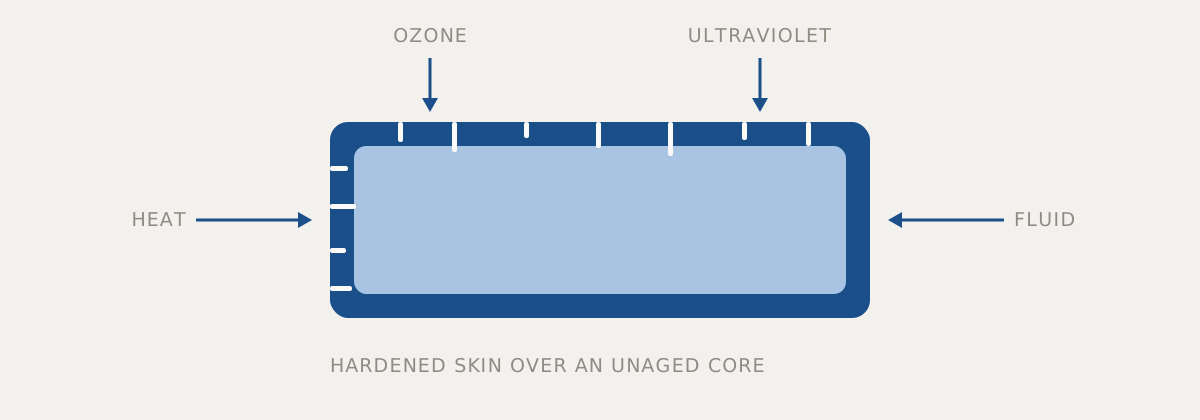
Design calculations for a rubber part usually end at load: what deflection, what force, what stress. The part then spends its life in an environment that slowly rewrites the network those calculations assumed, and long before anything is overloaded the material stops being the material that was specified.
Ageing is not one process but a family of chemical changes with different drivers, depths and symptoms. Separating them is the only way to work out which one will finish a particular part first.
Two opposite outcomes from the same cause
Whatever the initiating agent, the network responds in two competing ways.
Chain scission cuts the polymer backbone or the crosslinks. The material softens, loses strength, and in advanced cases becomes tacky. A seal that softens does not necessarily leak — it may conform better than ever — but it has lost the ability to resist extrusion and tearing.
Additional crosslinking ties the network more tightly. The material hardens, loses elongation and becomes brittle. This is what produces seals that shatter on removal and hoses that crack when they are flexed.
Both usually run at once, and which dominates depends on the polymer and the environment. The net change in a property such as hardness can therefore be small while the network structure underneath has changed enormously — the first reason a hardness check is a poor ageing indicator. It can read unchanged while elongation at break has collapsed.
Ozone needs strain, which is why the stored part is fine
Ozone attacks carbon–carbon double bonds in the polymer backbone. That reaction is fast, but it is confined to the surface, because ozone is consumed where it lands and does not penetrate.
The distinctive feature is that surface attack alone produces no damage. The surface must be under tensile strain, above a threshold, for a crack to open once a chain is cut. Below that threshold the reaction simply leaves an inert surface layer. Above it, cracks open perpendicular to the strain and then keep going, because each newly exposed crack tip is fresh material presented to the atmosphere.
That explains a pattern that gets misdiagnosed constantly: an identical part sits undamaged in a drawer for years and cracks in months on the machine. Nothing about the compound differs. One of them is stretched.
It also makes the damage diagnostic. A regular array of cracks all running the same way, perpendicular to an obvious strain direction and on the exposed surface only, is an ozone signature, and it points at installed strain as the thing to fix: a bend radius, an over-stretched ring on an oversized seat, a clamp that distorts the part.
Protection is normally chemical, and the mechanism has an expiry. Antiozonants migrate to the surface and react there in place of the polymer — a finite reservoir being consumed, which can also be washed off, wiped off or extracted by a fluid. A part protected this way is protected for a period rather than permanently, and the period ends sooner if the part is regularly cleaned.
Ultraviolet light and heat both act through oxidation, at different depths
Ultraviolet photons carry enough energy to break bonds directly and, more importantly, to initiate oxidation chains. The radiation is absorbed within a very short distance of the surface, so the result is a hard, crazed skin over an unchanged interior — a fine random network of cracks on the sun-facing side, rather than the oriented array ozone produces.
It is also the mechanism behind the most visible convention in the industry. Carbon black is an extremely effective ultraviolet screen: it absorbs the radiation in the outermost layer and dissipates it as heat, protecting everything beneath. A light-coloured compound in outdoor service is making a deliberate trade and needs a different protection system to make up for it.
Thermal ageing is oxidation without the photon: heat raises the rate of the same chain reactions, steeply and non-linearly, so a modest reduction in the temperature a part actually experiences buys a disproportionate amount of life.
Its subtlety is that it is frequently limited by oxygen supply rather than by temperature. Oxygen must diffuse into the rubber and is consumed as it goes, so in a thick section the reaction near the surface outruns the diffusion behind it: the outer layer ages hard while the core stays essentially unaged. The part ends up as a stiff shell bonded to a compliant interior, with a built-in stress concentration at the boundary and bulk properties that look far better than its behaviour. That gradient is why thin test sheets mislead about thick parts, and why a hardness reading taken on a surface is not a reading of the part.
Chemical exposure is two separate phenomena
Fluid contact is habitually described as one thing. It is two.
Physical interaction is solubility. A fluid whose molecules resemble the polymer’s own segments dissolves into the network and swells it: the polymer is not damaged, it is diluted. Swelling lowers stiffness and strength and, in a confined gland, can raise contact stress far above the design intent or force material into a clearance gap. The mechanism also works in reverse, with plasticiser migrating out into the fluid so the part shrinks and stiffens — so a compound that swells modestly may be in better condition than one that has lost its plasticiser.
The asymmetry that matters is reversibility. Absorbed fluid can leave again, and a seal that has swollen and then run dry will shrink back, sometimes below its original size, and leak. Extracted plasticiser does not come back at all.
Chemical attack breaks bonds. Depending on the polymer and the fluid, the target may be the backbone, the crosslinks or a linkage in a hard segment. This is irreversible and it is not proportional to swelling — a fluid can attack a polymer while barely swelling it, which is why a volume-change measurement alone is an incomplete compatibility test.
Why accelerated testing is easy to get wrong
The standard way to reach a durability answer within a project schedule is to raise the temperature and shorten the test, assuming the same reactions are simply happening faster.
That holds over a range and then stops. Different degradation reactions have different sensitivities to temperature, so raising the test temperature far enough changes which reaction dominates. The test then measures, quickly, a mechanism the part will never encounter — and produces a number that ranks compounds in an order service does not reproduce.
Diffusion limitation causes a second, quieter error: a thin specimen ages uniformly where a thick part ages in a gradient, so the test cannot show the hard shell, and therefore cannot show the failure that starts at its boundary.
None of this makes accelerated testing useless — it makes it comparative. Read as a predicted service life for a particular part, in a particular geometry, in a different thermal and chemical environment, it has been asked a question it was never constructed to answer.
The practical stance is unglamorous. Identify which single mechanism is most likely to end this part: strain plus atmosphere, sunlight, temperature, or the fluid. Design against that one directly, usually by removing the driver rather than by seeking a more resistant compound. And treat the part as consumable, because it is.